Original text in Chinese by Watershed Hong Kong
There was once a secondary school principal who miraculously recovered from a war injury and immediately returned to the frontline, for he was determined to defend his homeland. This person is Major Evan Stewart, a former principal of St. Paul’s College, and also a member of the Hong Kong Volunteer Defence Corps (later renamed to the Royal Hong Kong Regiment (The Volunteers) “(RHKR(V)”). Out of the six people who have been awarded the Distinguished Service Order since the opening of Hong Kong in 1841, Major Evan Stewart is the only local Hong Kong citizen being honoured who belongs to local militia instead of regular army.
Tragedy at a Young Age: Losing Parents in China
Stewart was born in 1892 and moved to Gutian Station, Fujian Province with his missionary parents when he was a child. In 1895, his family was attacked because of xenophobia. Stewart’s parents, older brother and younger sister were killed, while he was rescued by his older sister from the fire. After that, Stewart and his surviving siblings grew up at their grandfather’s house in Dublin, Ireland.
Stewart graduated from college in 1910. He then travelled to Hong Kong and started teaching at St. Paul’s College, where his older brother was the principal. In the same year, he joined the Hong Kong Volunteers and was quickly promoted to officer since he had received training before. He returned to Dublin to study at a university in 1913. The fierce fighting of the Great War 1915 made Stewart determined to join the army, even though he was exempted from military service as he was studying at university. Stewart served in the Middlesex Regiment and was injured twice from the battle. At the end of WWI, Stewart rose to the rank of captain and was given the acting appointment as a major.
Stewart returned to Hong Kong in 1920 to teach at St. Paul’s College and became its principal ten years later. In the Hong Kong Volunteer Defence Corps, he was responsible for the formation of the No.3 Company which was formed by Eurasians, and he was the Officer-in-charge.
An Appropriate Evacuation: An Escape from Death and Fight Back
At the beginning of the Battle of Hong Kong in 1941, Stewart led two platoons in the No.3 Company to station at Stonecutters Island. After the Japanese forces took control of Needle Hill, they set up artillery observation posts there and commanded the artillery soldiers in Kam Tin to bombard Stonecutters Island that had batteries. Stewart calmed his subordinates, then properly arranged an evacuation with the Royal Engineers and artillery units. On the night of 11 December, the troops successfully returned to Hong Kong Island from Stonecutters Island, and there were only 4 injured soldiers in the No.3 Company.
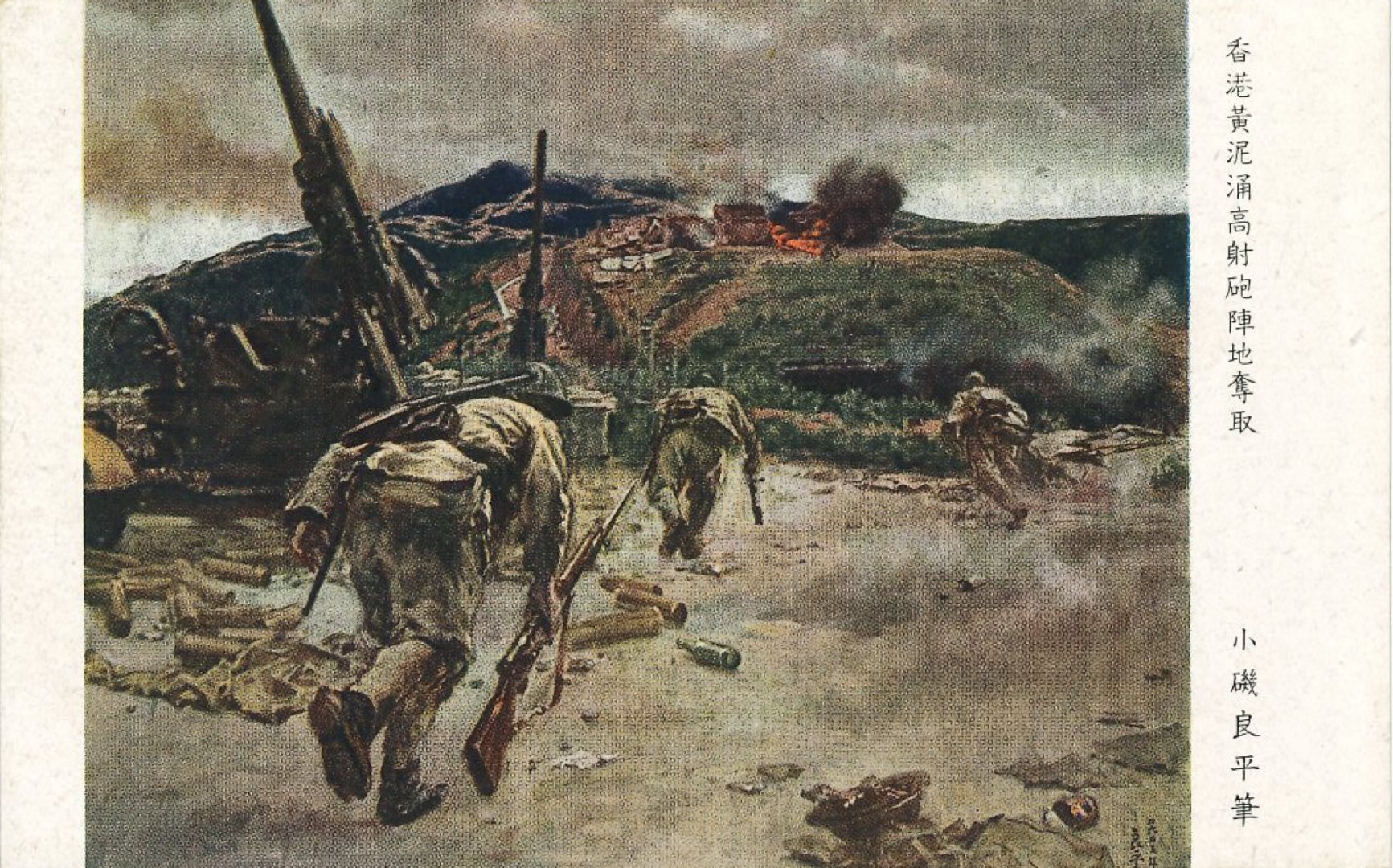
Japan issued a set of three postcards “The 2nd Anniversary of the Greater East Asia War (大東亜戦争2周年)” in 1943. The postcards depicted the attack on Pearl Harbor in Hawaii, anti-aircraft gun position in Wong Nai Chung, Hong Kong, and the capture of British soldiers in Singapore. The Hong Kong war scene was selected as one of the three major war events indicating the importance of the Battle of Hong Kong to the Japanese, and the intensity of the Battle in Wong Nai Chung Gap.
After the Hong Kong Garrison withdrew to Hong Kong Island, the No.3 Company stationed at the pillboxes and machine gun positions at Jardine's Lookout. Stewart settled the Company next to the anti-aircraft gun position 500m away from the West Brigade Headquarter. In the early morning of 19 December, a large number of Japanese soldiers attacked Jardine's Lookout and No.3 Company tenaciously resisted. The Japanese described the position as heavily guarded and requested support of the suicude squad. Sewart’s right shoulder was shot during that time and required treatment in a Company bunker below the west side of the AA battery. The Japanese did not enter the bunker probably because it was on the other side of the bombardment .
The seven soldiers from the No.3 Company in the bunker realised that it was difficult to wait for reinforcement for a counter-strike, so they decided to escape on the night of 22 December. They were divided into four groups and had 15 minutes in between during the evacuation. Stewart was the last to leave the bunker and the Japanese sentry heard a noise and fired. Fortunately, he did not get hurt. The No.3 Company at Jardine's Lookout almost all died while fighting at Wong Nei Chung Gap but there was another squad of eight who successfully evacuated to Stanley.
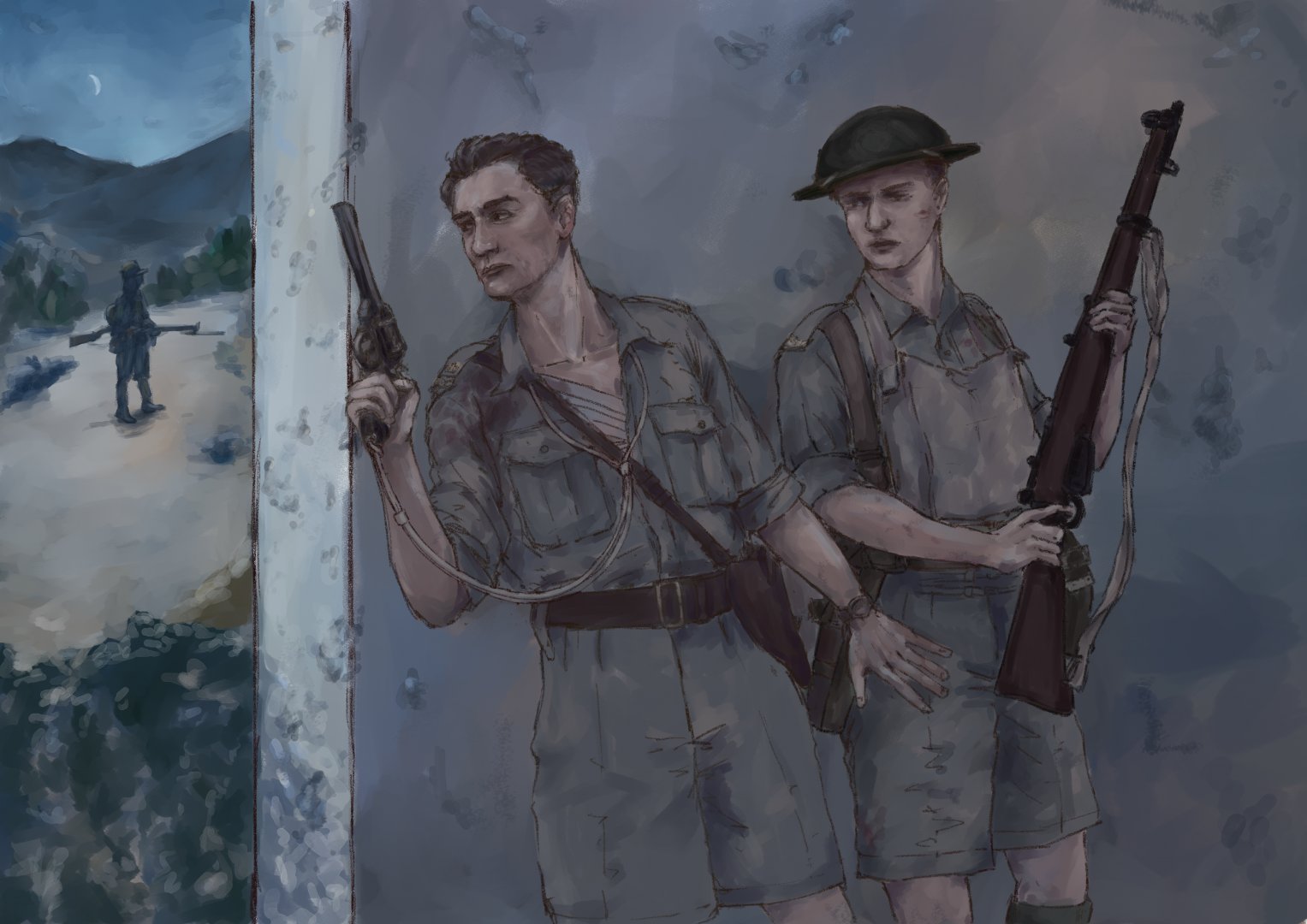
Stewart and his group headed northwest towards Causeway Bay and assembled with another 35 soldiers from the Z Company of the Middlesex Regiment in Leighton Hill. He briefly wrapped up his wound at Hong Kong Hotel (now the Central Building in Central), then continued to search for other members of the No.3 Company – who had been assigned to the urban area to join the air defense of the No.6 Company of the HKVDC after the withdrawal to the Island. Together, they just had enough member to form a platoon and return to the frontline in Wan Chai, until the fall of Hong Kong on 25 December. The No.3 (Machine Gun) Company suffered heavy casualties from this battle, with 72 casualties among 114 people.
After the war on 21 November 1945, Major General Christopher Michael Maltby wrote a report on the Battle of Hong Kong to London. In his closing notes, he praised the Hong Kong Volunteer Defence Corps, specifically pointing out the heroic performance of an unofficial force, the No.3 Company.
“In closing my dispatch I wish to pay a special tribute to the Hong Kong Volunteer Defence Corps. They proved themselves to be a valuable portion of the garrison. In peace they had surrendered a great deal of their leisure to training, their mobilisation was completed smoothly and quickly, and in action they proved themselves stubborn and gallant soldiers. To quote examples seems almost invidious but I should like to place on record the superb gallantry of No.3 (Eurasian) Company at Wong Nei Chong Gap and of No.1 Battery who undertook infantry defence in the Stanley area, while the efficiency and gallantry of their Signal section and dispatch riders were outstanding.”
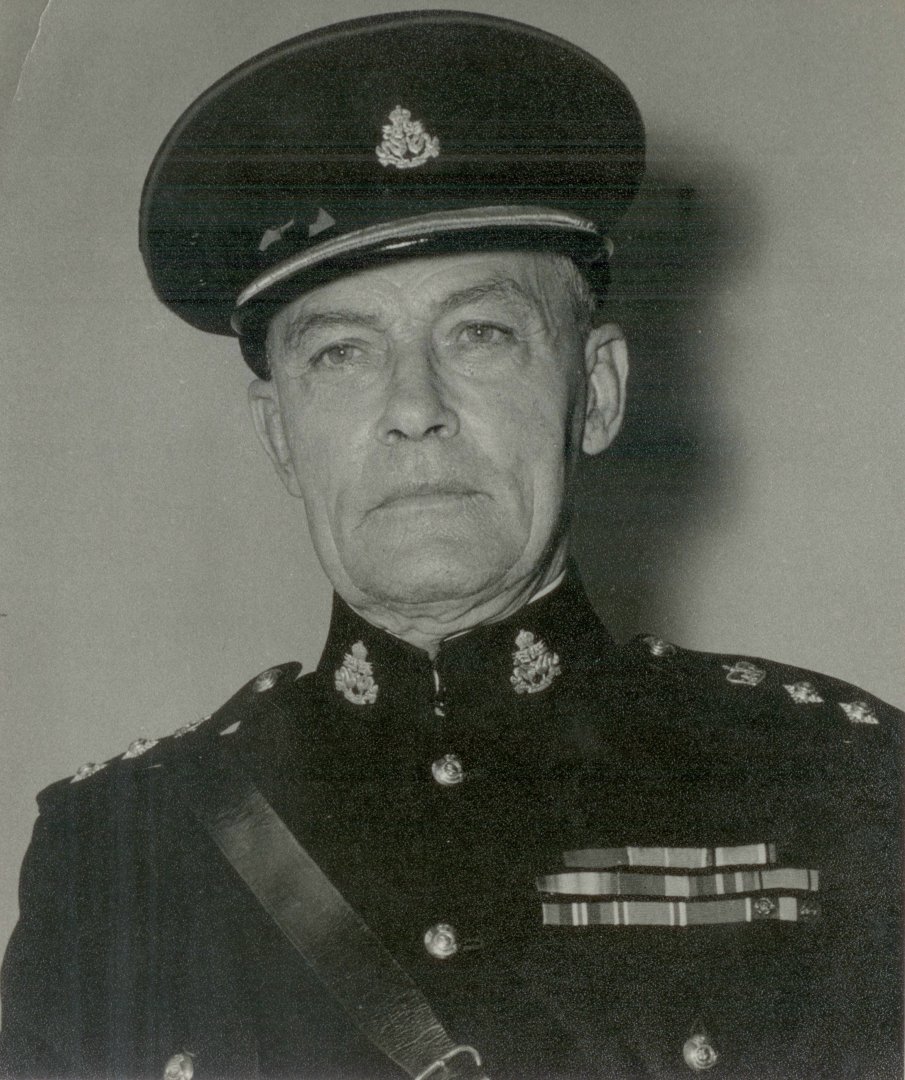
In 1958, Colonel Evan George Stewart from the Royal Hong Kong Regiment is pictured wearing a No.1 Dress.
(Photo credit: St. Paul's College 聖保羅校史館)
Reference:
Evan Stewart. (2020) Hong Kong Volunteers in Battle. Hong Kong: Blacksmith Books.
Bruce, Phillip. (1991) Second to None: the Story of the Hong Kong Volunteers. Hong Kong: Oxford University Press.
Kwong, Chi Man, and Yiu Lun Tsoi. (2014) Eastern Fortress: a Military History of Hong Kong, 1840-1970. Hong Kong: Hong Kong University Press.
Cracknell, Philip. (2019) Battle for Hong Kong, December 1941. Hong Kong: Amberley Publishing.
Banham, T. (2003). Not the Slightest Chance: The Defence of Hong Kong, 1941. Hong Kong: Hong Kong University Press.
National Archives. “The Discovery Service.” Recommendation for Award for Dewar, Arthur John Rank: Captain Regiment: … | The National Archives. The National Archives, August 12, 2009. https://discovery.nationalarchives.gov.uk/details/r/D7370167.
The Gazette.” Page 1671 | Supplement 37521, 2 April 1946 | London Gazette | The Gazette. Accessed December 31, 2019. https://www.thegazette.co.uk/London/issue/37521/supplement/1671.
Veterans Affairs Canada. “Distinguished Service Order (DSO).” Veterans Affairs Canada, February 14, 2019. https://www.veterans.gc.ca/eng/remembrance/medals-decorations/details/40.