Text: Jasmine Nunns / Photos: Lemontea Photography
What does it mean to belong to the land that you walk on?
Belonging has been the topic of conversation on many mouths in the past year, as the diverse population of those who identify with being a Hong Konger are faced with questions around what it means and feels to belong to this homeland which is undergoing so much change.
Having grown up in the Lam Tsuen valley in Tai Po, I too know the feeling of slowly watching my home, this piece of land I belonged to, change. Sometimes dramatically, and sometimes in the most subtle ways.
I watched how the trees I used to climb and build shelters in, were cut down to build another village house. The marsh was filled in with concrete to provide more space for cars to park. The river that we used to play and swim in, was filled with concrete to mitigate flooding.
I mourned for the trees, the marsh, the river, though I was not aware of it at the time. The sadness, loss and grief I felt only became conscious to me as an adult. It was that grief that guided me to a path of facilitating ways in which we can rebuild and restore our connection with the living Earth. Because when we are in a loving relationship with something, we don’t need to be told to take care of it, it becomes instinctive, a behaviour embodied within us.
Many of you reading this will have at least one, if not many memories and experiences of connections to draw from. Whether they are on the trails, coastlines, forest of Hong Kong or distant lands you and your ancestors are from or have travelled. I’m betting that all of you will have a story to share about a time you spent with a tree, or a rock, a mountain, or a body of water.

We all accept that communication and dialogue are exchanges between two people. I am willing to bet that those of you with pets at home will speak to them too. Yet, our culture seems to believe it is ‘wrong’ or ‘strange’ to be in dialogue with the Earth, though many indigenous cultures and their language will support the animacy of the living world, speaking to rivers just as they would to their grandmothers, and caring for the land just as the land was an extension of our own bodies.
This is a fundamental aspect of eco—psychology, a remembering that we are intrinsically linked to this Earth. The health of our planet is mirrored in our body and psyche, and visa versa. We are all woven to this place and are OF the Earth. Think about it, the minerals in your bones, teeth and hair, are the same that are found in the rocks. The saltiness of your tears, blood, and the amniotic fluid that carries unborn children are the same of that in the ocean. The veins that carry our blood and neural networks in our brain mimic the lightning strikes and riverways. If you ever doubt your belonging to the natural world, all you need to do is remember this incredible body you live in.
So what is it we can do to deepen and restore our relationship with the natural world?
Slow down.
In a city like Hong Kong where from the moment we wake, we’re already going somewhere. To that next meeting, to pick up the kids, to the gym… Our bodies and nervous system are primed to be on hyper-alert to the many stimuli that come our way living in a dense urban space. It's exhausting. Stress has become something we learn to cope with or numb, given the present and constant way it pervades our life. It was also found earlier this year that 40% of Hong Kongers suffer from some form of insomnia, especially in light of the social unrest we have experienced in the past year. This is significant as sleep is one of the most important times in which we restore our mental and physical bodies. Humans are hard-wired for connection, relationship, and attachment, and yet there are a million ways in which we separate and disconnect ourselves from community, from Nature, and from our very own bodies.
The science and research is finally showing what it is we and our ancestors already know. Just how restorative it feels to be in connection with the natural world. A gentle walk in the forest can lower our cortisol levels (stress hormone indicator), can regulate our circadian rhythms and improve quality of sleep, it can boost our immune systems, improve our mood, bring a sense of clarity and peace that comes from the practice of noticing what is in the present moment and giving our nervous system a break from living in survival mode where it feels like we’re alone in our experience of the world.
Connection is the remedy.
So slow down.
Notice.
Notice the feeling of the wind on your skin. Notice the colours, textures and playfulness of the natural world. Notice the smells as you walk, notice the sounds, and challenge yourself to listen to the quiet sounds, the shy ones. We can only do this when we go slow. Coming back to being fully in your body is part of the therapeutic element, as is the sense that we are connected to the land, a remembering that you belong here and that the Earth loves you back.
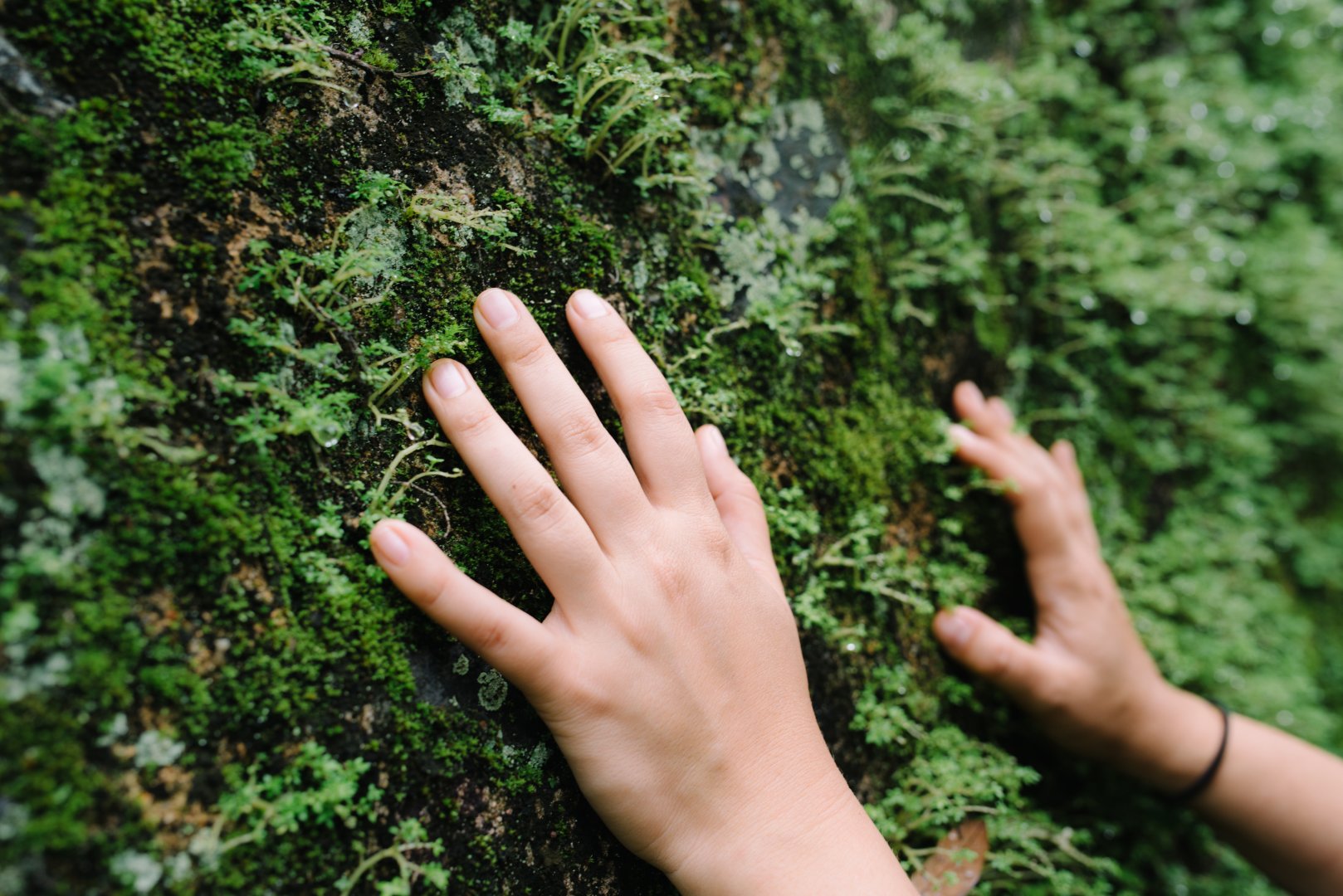
So the next time you go for a walk, give yourself a moment to slow down. Where it feels safe, take off your shoes and treat yourself and the Earth with that connection. Listen, smell, taste, touch and witness what exists with you on the trail. Practice stillness, even just for a moment.
Finally, remember to offer gratitude and thanks. Sometimes I notice a beautiful leaf that has fallen, and place it by a tree or a rock as a symbol, a gift. Other times I just allow myself to bathe in that sense of awe and wonder, and I know the Earth feels that.
Remember that the relationship we have with this Earth is not singular, it’s a two-way relationship. Remember those telephone lines we used to make as children with two tin cans and a string? Pick up your tin can and share, rebuild that relationship. You may even notice that the Earth speaks back to you on the other end of the line.
Kembali Website: https://www.kembali.org/
Kembali Facebook: https://www.facebook.com/KembaliHK/