Country parks usage up 260% since 1990
Can the parks support the influx of visitors?
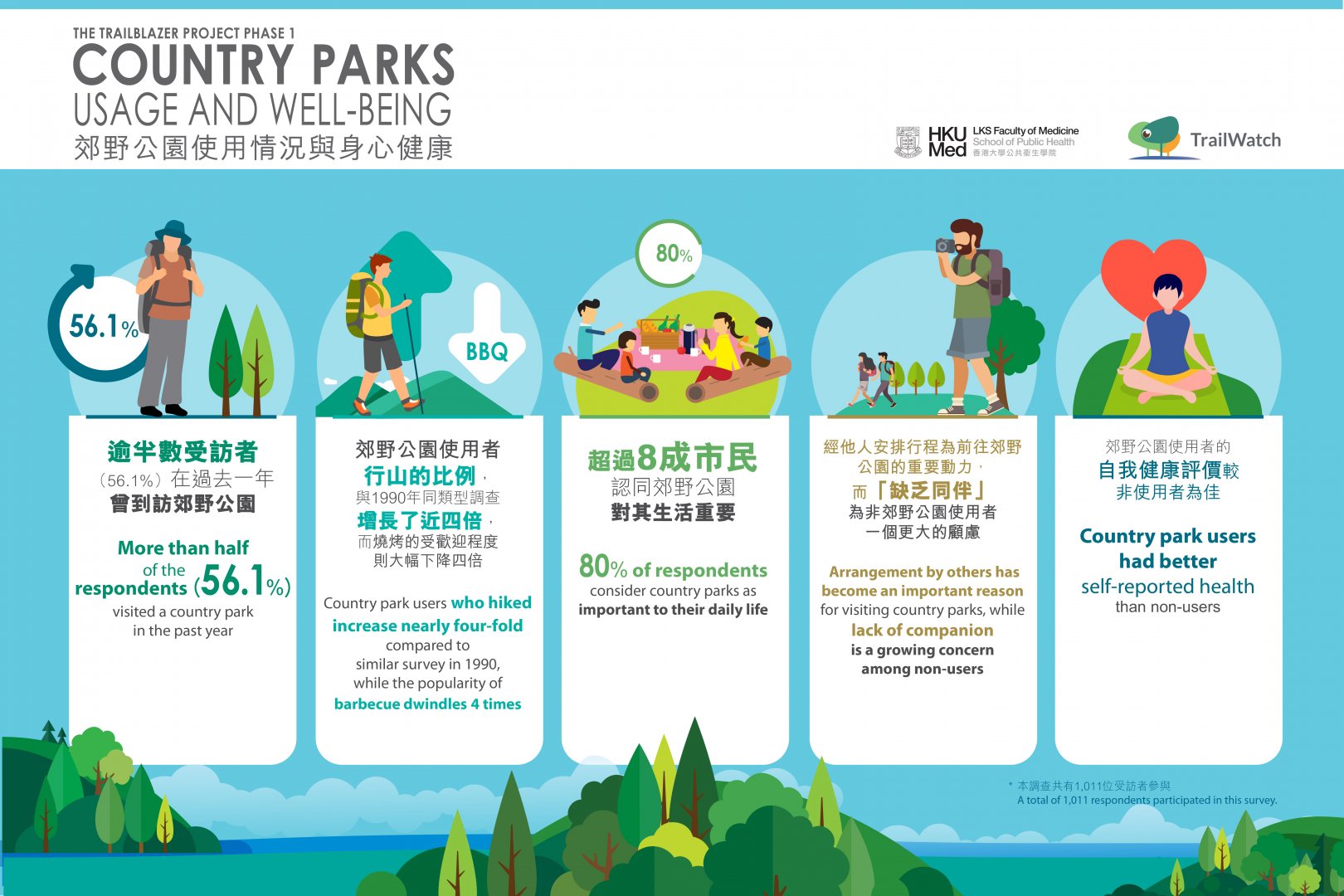
TrailWatch and the School of Public Health of the University of Hong Kong conducted a series of phone interview in 2018 to understand the usage of country parks and its associations with the physical, mental and social well-being of Hong Kong residents. 1,011 respondents were interviewed. Results revealed that compared to similar survey conducted in 1990, respondents who visited the country parks in the past 3 months increased by 2.6 times, estimated to be 2.08 million people. Over half (56.1%) respondents visited the country park in the past year with an average 5.9 visits.
The last survey on usage of country parks was conducted in 1990. Hiking, leisure walk, and barbecue are among the most common activities in country parks. Almost half of the country park users (47.0%) hiked in their last country park visit, and they hiked for almost 2.5 hours on average, fulfilling the World Health Organization’s recommendation of 150 minutes of weekly physical activity in one setting. Over 80% of the respondents found country parks to be important to their life. The top three reasons respondents cited for visiting the country park are good scenery, visit arrangements by others, and convenient transport. The lack of time, interest, and companions are the major barriers why country park non-users did not visit country parks.
Demographic and well-being comparisons were made between country park users and non-country park users. Compared to non-users, country park users tended to be young male and have a higher household income. Preliminary analyses suggest that country park users had better self-reported health and happiness than non-users, and the more frequent the visit to the country parks, the higher level of self-reporting health and happiness. 59% of country park users are healthier than the average non-users.
The survey results collected in the current study were compared with onsite visitor surveys conducted between 1982 and 1991 and the General Household Survey conducted by the government in 1990. In 2018, 32.9% of our respondents visited country parks in the past three months, which was 2.6 times more than the number recorded in 1990 (12.7%). Although hiking, leisure walk, and barbeque remained the most popular activities during country park visits over the decades, the percentage of country park users who hiked increases nearly four-fold (12.6% in 1982-1991 to 47.0% in 2018) while the popularity of barbeque dwindles (40.6% in 1982-1991 and 11.0% in 2018). This suggested that Hong Kong people have been switching from more sedentary activities to more active ones when visiting country parks.
Arrangement by others became a more popular reason for visiting country parks in 2018 (28.3%) than in 1982-1991 (8.0%), and the lack of companion is a growing concern among non-users in 2018 (18.5%) than in 1982-1991 (4.5%). The survey results reflected that Hong Kong citizens are increasingly using country parks as a natural green environment for hiking, where the average hike would fulfil the WHO’s recommended level of weekly physical activities. Hiking trips planned by either friends and families or social organizations may be a viable method to connect the city-dwellers with the nature.
Significance of the study
The study offers an updated overview of country park usage in Hong Kong since 1991. The research team is also among the first to investigate the relationships between patterns of country park visits and health, happiness, and family harmony. TrailWatch has always been focusing on promoting nature conservation and hiking in Hong Kong. We expects that the study would provide useful data for the government when developing relevant policies on country parks, including management, facilities and public education. TrailWatch believes the perception of country parks has changed amongst the public, physical activity has become the main activity in country parks. It is evidence that the loading of the trails in country parks has increased tremendously over the past 30 years, we believe that the government should carry out comprehensive study on carrying capacity of country parks and the impact of the natural habitat due to the increase in hikers. With the upcoming Trailblazer Project Phase 2, which is due to launch in the format of household face-to-face interviews in 2020, we aim to achieve the goals of providing an in-depth and comprehensive analysis of the role of country parks in the wellbeing of the population and ultimately formulating evidence-based health promotion strategies.