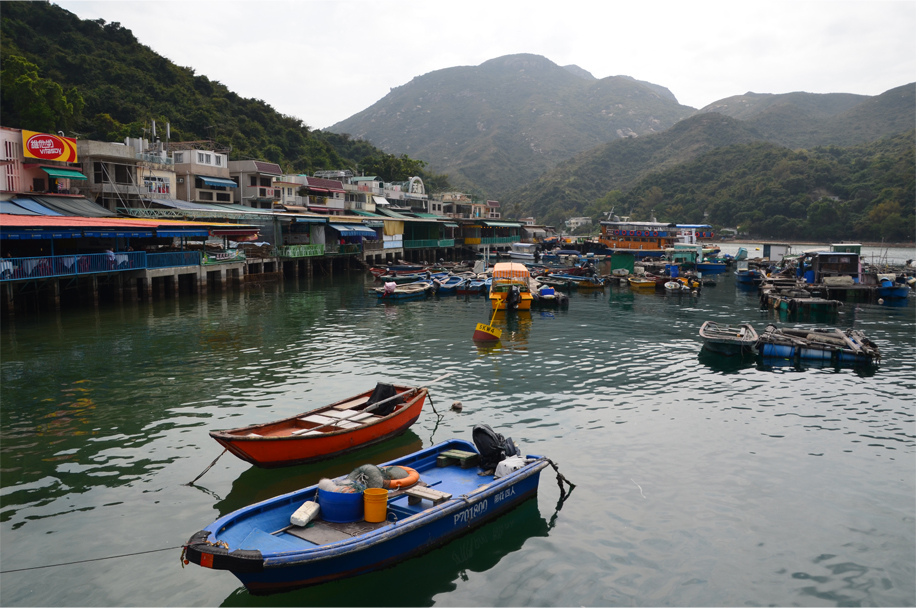
Restaurants of Sok Kwu Wan and Mount Stenhouse in the background
The last time I set foot on Lamma Island, before taking Bama there this Chinese New Year, was at least four or five years ago on a boat trip with a pack of old friends. The name Lamma, literally ‘Southern Y’ in Cantonese, is a reference to the heavily indented coastline which resembles two forks, one pointing northwards and the second facing east.
Lamma packs in plenty of rural charm in an area of less than 14 square kilometres. Weekend day-trippers come for the seafood restaurants and floating fish farms at Sok Kwu Wan, a sheltered, picturesque bay within sight of the skyscrapers on Hong Kong Island. Casual walkers – and increasing numbers of Mainland Chinese tourists – tread the concrete path running towards Yung Shue Wan, itself a haven for expats in search of an alternative lifestyle. More serious hikers head south to the quieter trails winding up Lamma’s highest peak, Mount Stenhouse.
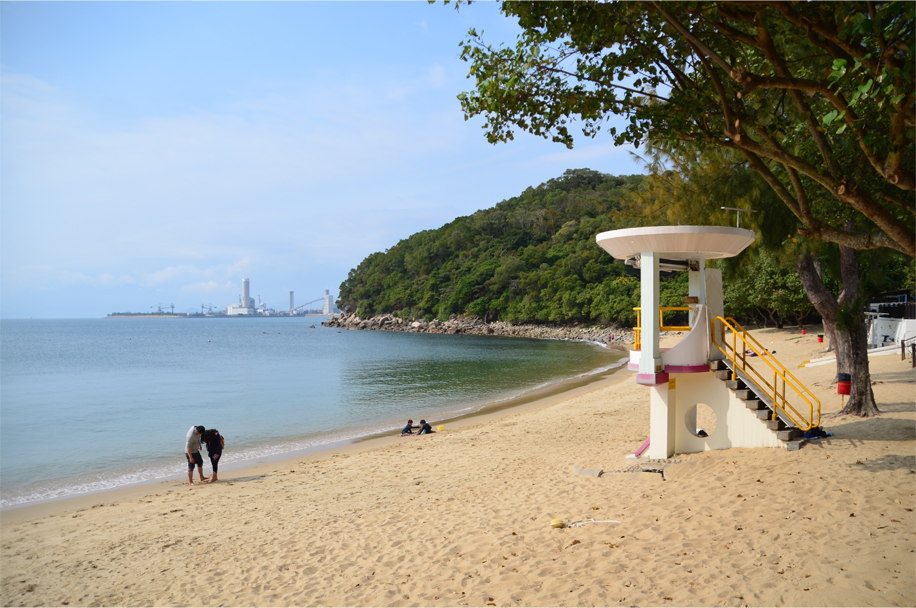
Lo So Shing Beach
Unknown to many, two local household names have their roots on these outlying islands. Neighbouring Cheung Chau gave Hong Kong its champion windsurfer Lee Lai Shan, the territory’s first Olympic gold medallist, while international film star Chow Yun-fat grew up in Tung O village, perched on Lamma’s southeastern shores.
Although the island is just a 25-minute ferry ride from the mad pace of Central, it feels vastly different. Even now its byways are ruled by those on foot and bicycle; the only motor vehicles are tiny fire trucks and ambulances, custom-made to fit the narrow streets.
But here the rugged landscape also bears the imprints of man. The north side of Sok Kwu Wan is marked by an an abandoned, overgrown quarry – there are now plans to redevelop the site and double the island’s existing population of 5,900. Over the hillside a far more intrusive presence protrudes into the sea. Since 1982, Lamma’s distinguishing landmark has been a coal and gas-fired power station, whose three smokestacks loom over the sands of Hung Shing Ye Beach. It’s a paradoxical sight that is strangely typical of Hong Kong.
Original article and more photos are available at Plus Ultra